Viking Serial Number Lookup: Find the Tag and Read It
Your Viking serial number is on a printed rating tag: behind the kick panel on most ranges, on the oven frame inside the door, inside the refrigerator near the top, and on the dishwasher door edge. Read it with the model number to learn the series and roughly when it was built.

For a Viking serial number lookup, start at the appliance rather than a search box. The model and serial number are printed together on one rating tag. On most Viking ranges it sits low on the front behind the kick panel, on a wall oven it is on the frame you see with the door open, on a built-in refrigerator it is inside near the top, and on a dishwasher it runs along the edge of the door. Take a photo of it, then read the model number for the series and the serial for the production run.
Having both codes ready is the quickest route to a correct repair. A Viking that went in with a remodel twenty years ago and one installed last spring can look nearly identical from across the room and still take completely different parts. In Brookline condominium kitchens, where panelled refrigerators and dishwashers are fitted flush with the cabinetry, that small tag inside is often the only place the appliance still says what it is.
Where the tag hides on each Viking appliance
Viking puts the model and serial on a single printed label, usually a silver or white sticker with a barcode. Most of these spots sit in shadow, so bring a flashlight.
Ranges
On most freestanding Viking ranges the tag is at the bottom front. Remove the kick panel, which on many models lifts off or is held by a couple of screws, and look at the frame behind it. If nothing is there, crouch down and look up under the lip of the control panel, then check the opening behind the storage or broiler drawer. Avoid pulling the range out of its opening to hunt for a label on the back. These ranges are heavy, the gas connection behind them is short, and the tag is almost always reachable from the front.
Wall ovens
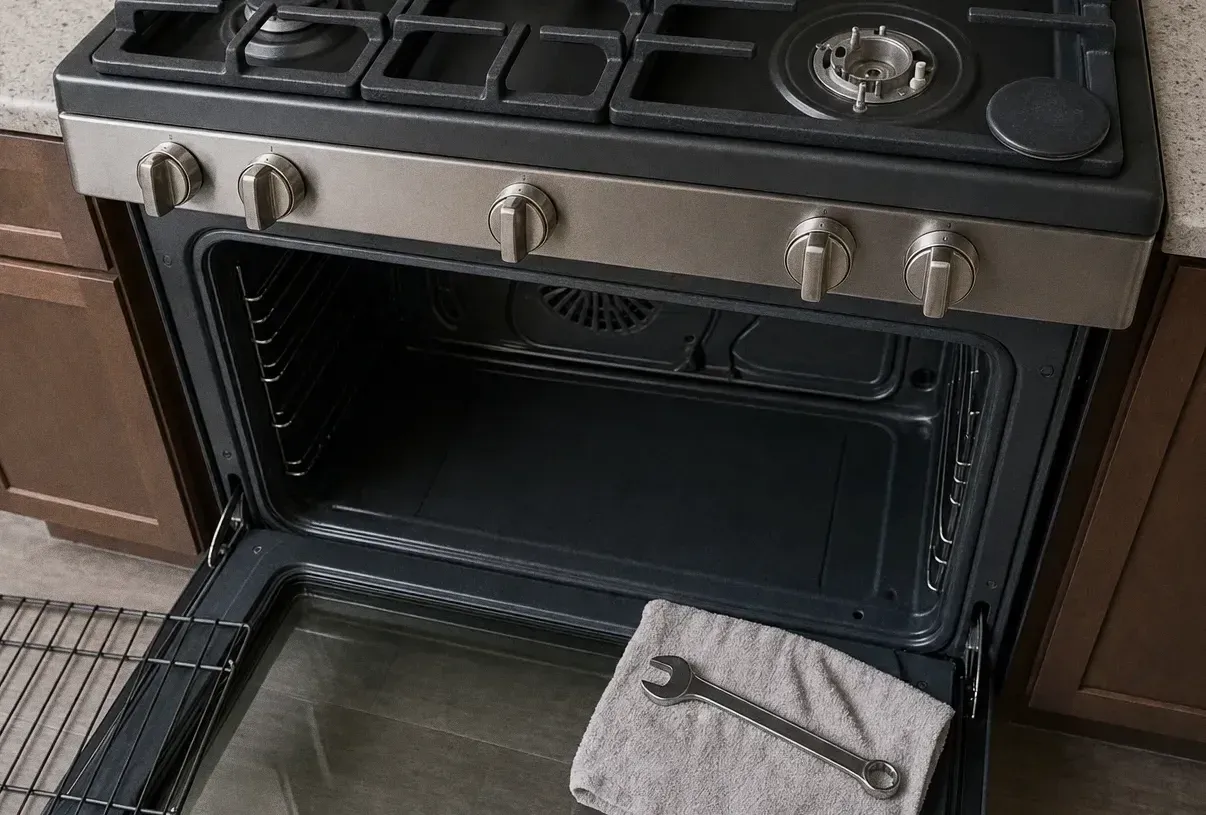
Open the door all the way and study the frame around the oven cavity, on the side trim or just below the control panel. On a double oven, check around the upper door first and then the lower one.
Built-in refrigerators
Look inside the fresh-food section near the top, on the side wall or the ceiling close to the light. On some built-in models the label sits behind the grille above the doors, which tilts or lifts away. A panel-ready unit is no different inside; the wood on the front only hides the badge.
Dishwashers
Open the door and run your eye along its edges, on the side or top of the inner door. Because it only shows with the door down, people often own a dishwasher for years without ever noticing it.
Once you find the tag, photograph it straight on in good light, and tape a note of both codes inside a nearby cabinet door. Labels fade with heat and cleaning sprays, and a range tag can be hard to read after a decade of cooking.
Reading the model number: series, fuel and width
The model number is the code a homeowner can actually make sense of. On current Viking ranges it names the product tier, the fuel and the width, followed by details of the cooktop and a short color code at the end.
The series is usually what people are hunting for. Viking sells its professional-style ranges in three tiers. The 3 Series is the entry tier, the 5 Series is the heavy commercial-look line most people picture when they hear the name, and the 7 Series sits at the top with the most features. A 3 Series model number usually opens with the letter R. A 5 Series or 7 Series number usually shows a 5 or a 7 as the first digit after the opening letters. Ranges built before these numbered tiers were introduced belong to older lines and carry no series digit at all, which is itself a clue to their age.
Fuel shows up in the letters too: G for gas and D for dual fuel, with other letters used for electric and induction models. The width in inches appears as a pair of digits, commonly 30, 36, 48 or 60, and the characters after the width generally describe the cooktop layout, such as the number of burners or whether a griddle or char-grill takes the place of some of them.
Refrigerator, wall oven and dishwasher model numbers use their own letters; pass those along whole rather than translating each character.
What the serial number can and cannot tell you
The serial number identifies your exact unit and ties it to a production run. That matters more than it sounds. Viking, like every appliance maker, changes components partway through a model’s life, so two ranges with the same model number can need a different igniter or control board depending on when each one was built.
Age is the question most people bring to a serial number decoder, and some caution helps here. Viking does not print a decoding key in its owner materials, and the format has changed over the decades, so charts found online are guesswork at best. Look first for a manufacture date printed on the tag or on a sticker nearby. If there is none, the manufacturer’s customer service can date the unit from the serial, and so can a technician who works on the brand regularly.
Paperwork brackets the age too: the remodel invoice, the product registration or the print date on the owner’s manual. If the kitchen came with the house, the appliances may not match the age of the cabinets, so check rather than assume.
Why your technician asks for both codes first
Most Viking repairs come down to getting the right part. The diagnosis shows what failed; the model and serial show which version of that part your appliance takes. Sending both when you book lets the technician pull up the parts list and carry the likely parts on the first visit instead of leaving to order them.
The tag holds other useful details as well. On a gas range it states the gas the unit was set up for, natural gas or propane, along with the burner ratings, which matters if the range has been moved or the supply changed. On a dual-fuel range it gives the electrical rating. When every burner keeps clicking, for example, the fix depends on the exact spark module and switches fitted to your range, and our guide to all the burners clicking at once on a Viking range walks through that fault. The two codes also let you check whether a safety notice applies to your unit, which is worth doing before paying for any repair.
When you call (617) 340-2816, keep the photo handy. Booking the visit costs $95, flat. That single charge buys the drive out plus the whole diagnosis, and should you say yes to the repair, it gets subtracted from your final invoice. Typical ranges help set expectations: an igniter or burner assembly usually runs $270–$630, and a control board or touch panel $400–$850, with a firm price once the fault is confirmed. More on that work is on our Viking range repair page.
Using the age to weigh repair against replacement
Knowing roughly when the appliance was built makes the repair decision easier. A well-kept Viking range is a long-lived appliance, and replacing an igniter or oven thermostat on one that has been cooking for fifteen years is often money well spent. A refrigerator is a different calculation. When the compressor or sealed system fails, that repair typically runs $1,060–$2,630, and on an older unit it is fair to weigh that against the price of a comparable new Viking plus the work of fitting it into your cabinetry.
Age also tells you about parts. On models long out of production some components grow scarce, and the model and serial let the technician confirm a part is still available before you commit. For a built-in unit, our refrigerator repair page covers that side of the kitchen.
Follow-up questions
Where is the serial number on a Viking range?
On most Viking ranges it is on a rating tag low on the front, behind the removable kick panel or on the frame just above it. If it is not there, look up under the lip of the control panel and around the opening behind the storage or broiler drawer. A flashlight and a phone photo make the small print far easier to read.
How can I tell if my Viking is a 3 Series, 5 Series or 7 Series?
The model number on the tag is the quickest guide. Current 3 Series models usually begin with the letter R, while 5 Series and 7 Series models usually show a 5 or a 7 in the first digit after the opening letters. Ranges built before the numbered tiers existed carry no series digit at all.
Can I tell how old my Viking is from the serial number?
Often, but not with certainty on your own. Viking does not print a decoding key for owners and the format has shifted over the years, so check the tag for a printed build date first. If there is none, the manufacturer or a technician who works on the brand can usually date the unit from the serial.
Why does the technician want the model and serial before the visit?
Because Viking parts are matched to the model and often to a span of serial numbers, so the two codes show which igniter, board or element your unit takes before anyone arrives. The same tag also states whether a gas range was set up for natural gas or propane.
What if the tag is missing or unreadable?
Check the owner's manual, the warranty registration card and the invoice from the kitchen remodel, since the codes are usually copied onto at least one of them. If none of those survive, a technician can often narrow down the series from the knobs, burners and control layout and then look for a second label inside the unit.